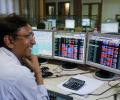
Equity benchmarks mustered gains for the first time this week on Thursday as investors piled into the recently-battered metal, bank and IT stocks amid expiry of monthly derivative contracts. Snapping its three-session losing streak, the 30-share BSE Sensex rallied 503.27 points or 0.94 per cent to settle at 54,252.53. On similar lines, the broader NSE Nifty gained 144.35 points or 0.90 per cent to end at 16,170.15.

For the Mizo people, tribal and family identity are important. But so are jobs, farmers' access to markets, roads, and health facilities for a young population where drugs are a big affliction.

'From a retail investor's perspective, therefore, it is essential not to get swayed by the short-term correction in the equity market and macro noise, and stay the course with their long-term financial plans,' notes Ashwin Patni.

The government will unveil the Consumer Price Index data and the Wholesale Price Index data for August on Monday.

L&T was the top gainer in the Sensex pack, spurting over 6 per cent, followed by Hero MotoCorp, HDFC Bank, IndusInd Bank, Maruti, HDFC and HCL Tech. On the other hand, ITC, SBI and Bharti Airtel ended in the red.

While a number of players invested more in Indian companies, another set exited the market, making profits after March. The companies that invested included Saif Partners, which made a $24 million investment in Network18, and Times Private Treaties, which acquired 12 per cent in Jiny & Jony (for an undisclosed sum), according to data with analysts and brokerage firms.
The main reasons for this latest rally include strong foreign institutional investor flows, healthy Indian and Chinese manufacturing data as well as less than severe Basel-III norms.
Any change in rates would mean more volatility; else, poll outcome-fuelled rally expected to continue.
India VIX has been mirroring the CBOE Volatility Index.

A new Congress leader may make an electoral impact by his very presence. Congress voters who had moved away from the party, after being influenced by the BJP's 'family rule' campaign, can now return with a certain moral satisfaction, observes N Sathiya Moorthy.

Equity benchmarks Sensex and Nifty gave up early gains to close in the red on Wednesday after a selloff in power, metal and consumer durable stocks amid a weak trend in global equities. However, a rally in the rupee against the US dollar and unabated foreign capital inflows helped the indices restrict the losses, traders said. In a largely range-bound session, the 30-share BSE Sensex ended 151.60 points or 0.25 per cent lower at 61,033.55.

The dollar index was up by 0.43 per cent against a basket of six major currencies as euro dropped against the dollar, after quarterly economic reports from France and Germany missed expectations, said analysts.

In line with Sensex, the broader indices also saw hefty losses. Large cap index tumbled 0.79 per cent, midcap 0.87 per cent and smallcap 0.57 per cent.

Experts tell Ujjval Jauhari that investors need to be careful in picking stocks given high valuations and with markets possibly ignoring potential risks

In the global markets, the US dollar traded lower in early trade after former US Treasury Secretary Larry Summers withdrew himself from the race to be the next Federal Reserve chairman.
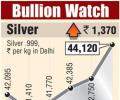
Traders attributed the rise in prices to higher demand of precious metals for the coming festivals like Rakshabandhan compared with supply, which has tightened because of fall in imports following government measures.

Indices across Indian equity markets have edged towards new record highs before undergoing a small correction in the past few sessions. The National Stock Exchange Nifty has gained 20 per cent in the past year; mid-caps (up 33 per cent), small-caps (up 31 per cent), and micro-caps (up 44 per cent) have done better. Several factors have precipitated this rally.

Positive cues from China - which accounts for 56.5 per cent of global crude steel production - are likely to keep demand-supply in balance and provide support to prices. All eyes have been on China, which opened after New Year holidays, as it was widely expected that prices would recover post-holidays after the weakness in January. Jayanta Roy, senior vice president, ICRA pointed out, barring last year when Covid-related restrictions affected China's steel demand in February 2020, historical trends show a typical upward movement in steel prices post-new year festivities. China's opening post-holidays was keenly awaited, especially in the wake of the sluggishness in the market in January.

Positive cues from Asian peers also uplifted the sentiment.

Bank shares were the top gainer in early trades with Bank of Baroda up over 4%.

Global gold demand has seen a year-on-year decline of 8 per cent during the April-June period to 948.4 tonnes and going ahead further monetary tightening and continued dollar strength may pose headwinds, says a report. According to the WGC Gold Demand Trends Q2 2022 report, the total gold demand during the second quarter of 2021 stood at 1,031.8 tonnes. The year-on-year demand was affected by increase in gold electronic traded funds (ETFs) outflow, decline in Central banks buying and lower demand from the technology segment, the report said.

Thus far in 2017-18, FIIs and MFs have invested Rs 198.91 billion and Rs 1,119.49 billion in the Indian equity markets. Of this, around Rs 152.46 billion has come in January alone.

Sensex gains 2.4%, Nifty crosses 7,000; investors feel exit polls have vindicated their stand
Asian shares ended higher after a string of positive US economic data.

'It is only fear and speculation, without much substance, that has led to the fall.'

Investor sentiments remained upbeat tracking global developments as the US, China geared up for trade talks due this week.

The benchmark Sensex companies' underlying earnings per share are down 3 per cent (on a cumulative basis) since January 2015, against 25 per cent rise in the index value during the period

An expert committee appointed by the Supreme Court said it cannot conclude any regulatory failure around Adani Group's stock rallies, and that Securities and Exchange Board of India (SEBI) has 'drawn a blank' in its probe into alleged violations in money flows from offshore entities into the conglomerate.

An expert committee appointed by the Supreme Court said it cannot conclude any regulatory failure around Adani Group's stock rallies, and that Sebi has "drawn a blank" in its probe into alleged violations in money flows from offshore entities into the conglomerate. But the six-member panel said there was an evidence of a build-up in short positions on Adani Group stocks ahead of the report of US-based short seller Hindenburg Research, and profiting from squaring off positions after prices crashed post-publication of the damning allegations. "At this stage, taking into account the explanations provided by Sebi, supported by empirical data, prima facie, it would not be possible for the committee to conclude that there has been a regulatory failure around the allegation of price manipulation," the panel said in the report submitted to the Supreme Court.
After cashing out of the recent stock market rally, investors aren't ploughing their money into just initial public offerings (IPOs), bonds or real estate. The feel-good factor has prompted many of them to splurge on luxury cars, exclusive holidays and designer brands.

Equity benchmarks snapped their six-session rally to close marginally lower on Thursday amid profit booking in banking and energy counters. Investors also stayed on the sidelines ahead of the RBI's policy meet outcome on Friday. In choppy trade, the 30-share BSE Sensex ended 51.73 points or 0.09 per cent lower at 58,298.80. During the day, it hit a low of 57,577.05 and a high of 58,712.66.

However, it still lags far behind the US, which leads with a market-capitalisation of $23.9 trillion through August 2014.

Sugar prices are hovering near six-year highs, leaving a bad taste in Indian consumers' palates but sweetening the portfolios of investors in related stocks at Dalal Street. Shares of sugar manufacturers such as Piccadily Agro, DCM Shriram, Magadh Sugar, and Bajaj Hindustan have rallied up to a whopping 200 per cent so far in the financial year 2024 (FY24) as deficient monsoon rains in major sugarcane producer states like Maharashtra and Karnataka are expected to lead to a shortfall in sugar output ahead. In comparison, the BSE Sensex has modestly gained 11 per cent during this period.

IndusInd Bank was the top gainer in the Sensex pack, rising around 2 per cent, followed by Axis Bank, HDFC, ICICI Bank, HDFC Bank, Kotak Bank and SBI. On the other hand, ONGC, Tech Mahindra, NTPC, Sun Pharma and TCS were among the laggards.

Capital Goods shares ended mixed on the back of weak IIP numbers. L&T ended down 0.7% while BHEL ended with marginal gains.

The rupee on Tuesday recovered from its all-time intra day low of 77.79 to close higher by 7 paise on a stellar rally in domestic stock markets. After opening lower at 77.67, the local unit plunged further to its all-time intra-day low of 77.79 due to a spike in crude oil prices and disappointing macroeconomic data. However, a strong rally in domestic equities helped the rupee rebound and close at 77.48 (provisional), showing net gains of 7 paise over the last close of 77.55. The forex market was closed on Monday on account of Buddha Purnima.

IT major Accenture's second straight cut in its revenue growth forecast for FY23 suggests there is more pain ahead for the Indian IT sector, say analysts. Accenture has lowered the top end of its FY23 growth guidance in constant currency (CC) to 9 per cent from 10 per cent earlier. The firm, which follows a September-August fiscal cycle, expects a 2-6 per cent CC growth in Q4 of FY23 (June-August 2023) versus the 6-10 per cent prior guidance.

'This fall is nothing. We could see worse if everybody hits the panic button.'

The BSE Sensex maintained its winning run for the fourth session on the trot on Wednesday to reclaim the 60,000-level after a gap of over four months as investors remained upbeat amid softening crude oil prices and persistent foreign fund inflows. A strengthening rupee and positive Asian markets further bolstered sentiment, traders said. The 30-share BSE benchmark jumped 417.92 points or 0.70 per cent to settle at 60,260.13 -- closing above the psychologically key 60,000-mark for the first time since April 5 this year.
